Categories
TURKEY

Dear Nahit, I wish I could do more than write this article.

I used to live in Turkey before I ended up here. I think it was 2012 when I started my first year in Istanbul Social Sciences High School and 2017 when I left for Canada. I haven’t been back since. I didn’t want to return anyways. At times, I find myself wondering what had happened and how we got to where we are today.

The boarding school I attended consisted of a very tight knit community. It made sense, considering it was also our home for 8 months of the year. There, I developed many skills from learning how to write effectively to forging  my parents’ signatures in order to  go out in the evenings. Like every student, I had some amazing teachers throughout my time at boarding school, as well as some that were… well, not so amazing.

That being said, there was one teacher that I may never forget… Mrs. Sema, the reason I fell in love with Turkish literature. Unfortunately, she passed away this year due to illness. 

She was graceful in the classroom. Mrs. Sema ran engaging discussions on poetry and theatre, gave us her undivided attention, showed patience with our every mistake, and smelled faintly of tobacco. She taught me how to write a research paper so flawless that I could have skipped going to my first year English lectures in university and it would not have made the slightest difference on my grades. I did get to thank her after I started my BA in the University of British Columbia and I am so glad that I sent her that text while sitting at the library alone, missing “home”.

Life is short, but the ways in which we are touched by people lives on. Stories are necessary to carry on these legacies that are left behind. As I write these words, I am intentional that somewhere ­–either on paper or a website page— it will forever say that Ms. Sema was an outstanding teacher who loved what she did and in turn, instilled that love within her students. I am sure we all greatly desire to leave behind a good legacy when we pass away, even if it is as simple as being remembered for our kindness.

At least I know I do.


My favourite place in Istanbul was Beyoğlu. Most would recognize it from the photos of the Galata Tower overlooking the Bosphorus. An iconic building for both locals and tourists in Istanbul. 

There is a well-known myth which says that if two people go up the tower together, they end up getting married sooner or later. I actually went there once with my best friend Ismail. We did end up getting married to each other, but I doubt it had much to do with the myth. Another inexplicable mystery of this universe.

For a very long time, the Galata Tower was a symbol of love for me and associated with my warmest memories. Now I sometimes think of the salty breeze coming from the sea, standing there, and looking up. I feel sorrow. I might even be making up the scene, but like I said, it’s been a while since I’ve been back.


I didn’t know Nahit when I was in high school to be honest. He was an upper year student, he played basketball, and my friend had a crush on him. Even though we shared the same halls at school, I do not remember much of him other than small bits and pieces of information.

His dad was a judge then, who has now been imprisoned for almost 7 years as part of the Turkish government’s purge of government officers. A lot of people have been accused of being terrorists since the attempted coup in 2016 (about 600,000 people give or take) and members of the Gulen Movement were affected most. Kurds and other dissenters were also affected, but to a lesser extent. The witch hunt led to some losing their jobs, being sent to prison, and many were excluded from their families, neighbourhoods, and friend groups because the accusation sticks and doesn’t let go. I would know. The affected were mostly teachers, police, lawmakers etc. Nahit’s dad was only one of those tried unjustly under the Presidential Law.

Nahit suffered from something called a ‘social death’. Stigmatised as a terrorist in his 20s, I can imagine why he could not talk to anyone about what he was going through. 

Imagine the fear of the future eating at you as you think of starting a career while also jumping through hoops to avoid getting profiled in job applications. The anxiety of knowing they won’t accept you if they learn about your dad. It is a drowning sensation and you cannot see the shoreline. People who see you drowning don’t lend a hand, some don’t even look your way and you can’t shout nor ask for help. His roommate of one year didn’t even know Nahit’s dad was in prison and had no idea how much he suffered.

People say Nahit was a kind soul. He was hardworking and silent. He got into the best university in Turkey, Boğaziçi University after he aced the entrance exams. He had a solitary life in his dorm room where he prayed often according to his roommate at the university. He had a tough time after his dad was imprisoned. Injustice made him distressed. Enough to be  diagnosed with bipolar disorder not long after his father was taken away from him and his family, which included Nahit, his younger sister, and his mother.

Nahit committed suicide at Galata Tower on October 12, 2022.

At first, journalists wrote that it was a foreigner who jumped and therefore, irrelevant. When a foreigner dies, it is of no concern to the public.

A week later they wrote that Nahit was simply depressed and sick, and claimed it had nothing to do with the injustice his community had inflicted upon him. Again, no concern of the public – the newspapers said so.

Against all the lies the Turkish media spread about his death, I bear witness to the injustice that killed Nahit. Life is ephemeral but our legacy lives on in people whose lives we touch ­– knowingly or unknowingly. As I write these words, I am intentional that someone, somewhere will read this and know that Nahit was a kind soul, that he tried standing up against the face of injustice, and when he couldn’t anymore, he was murdered in maybe the most public place in Istanbul. A place that used to hold a different meaning for each of us.

I am not sure what the Galata Tower symbolises for me anymore. I thought about pain, resilience, injustice, anger, but nothing summarises what happened to Nahit, especially my insufficient words.

Dear Nahit,

I wish I could do something more than write this article.

In the name of Allah – Al-Ghaffar, Al-Hakam, Al-Adl, As-Shaheed, Al-Muqsit, I pray that you find the justice you have yearned for in this world where you are.


This article was first published in The Muslim Voice Magazine Ephemeral Edition.

Categories
TURKEY

A Look Into the Turkish Justice System Through the Broken Glasses of a Teacher

On the night of the attempted coup in 2016, the Turkish Prime Minister Erdogan – without any official investigation had been completed, has accused the members of the Gulen Movement of trying to overthrow the government. This accusation against a large group of civilians has not been accepted to be true by any of the international organizations since then because the Turkish government has failed to provide hard evidence. Even though there isn’t any hard evidence, the Turkish government has been committing many systemic human rights abuses against the members of this group (and many other groups) such as torture, social death through firing them from their jobs, and unlawful imprisonment. My job is not to argue the innocence of the Gulen Movement as a whole but I am arguing for the right of an individual to a fair trial – which has not been the case in Turkey for a long time now. The human rights abuses that have been committed by the Turkish government have all been documented by international human rights watch organizations such as Amnesty International and HRW.

Almost a month after the attempted coup, the previous governor of Istanbul, Kadir Topbaş came up with a horrifying idea: a separate graveyard called the “Graveyard for Traitors” which would be reserved for members of the Gulen movement. Topbaş suggested that all members of this organization should be buried in a Grave of Traitors while withholding their rights to a religious burial. To provide some context, the accused were mostly teachers, government officials, students, and even homemakers who had no idea about what was happening. We will come back to this horrifying concept of a graveyard later in the post.

A photo of the Graveyard for Traitors. This was not only an idea, the government made sure that it became reality.

It was a  few days after the attempted coup when history teacher Gökhan Açıkkollu was fired from his position through an unlawful decree. A day later, the police came to his home and handcuffed him from his behind pushing him to the floor. The building manager was present at this point because he had unlocked the door for the police. His family was not present in the house.

While the cops were pushing him to the floor on his back, Açıkkollu went into diabetic shock. The police then applied an insulin shot but kept on brutally beating him up in that position, continuing with their questioning. At that point, the building manager told the police to take Açıkkollu to the police station instead of torturing him there because he could not stand watching what was happening. The police continued beating him up as they took him into the police car. There are reports of abuse and torture in his official health report as well as the first hand account from the building manager.

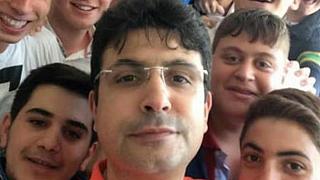
History teacher Gökhan Açıkkollu with his students

His wife Tülay Açıkkollu called police stations for the next four days demanding to know where her husband was taken but the reply was the same each time: “We can’t provide you with any information at this moment.” At the end of the fourth day, she was informed that Gökhan was at a police station in Istanbul. Later she learns that Gökhan was sent to the hospital because he got into more diabetic shocks during his time in the cell. The doctors gave a report stating that he can go back to his cell each time. In the next few days, he got panic attacks many times but each time he was sent back to the cell where he stayed with 4 others in a small room with three beds. A forensic specialist who was also in the same cell at the time reports that Gökhan would be taken out of the cell and brought back 8 hours later, severely beaten up. A lawyer who was also present in the cell reports that Gökhan cried on his shoulder many times in those 13 days they shared the cell. The cell mates gave a statement saying that they want to officially witness to the torture but the courts did not accept their statements. The case was closed.

One night, Gökhan gets a heart attack and even though everyone in the cell pleads to the guards, the guards do not take him to the hospital or provide any help for more than 30 minutes. Later he is taken out of the cell by the guards when he shows no sign of life. The surveillance camera records all of this.

A screenshot from the video recording that shows the last moments of Gökhan Açıkkollu. The guards did not help him for more than 30 minutes as he had a heart attack in his cell.

His family is later called to the forensic lab so they can take his body for the burial.

Human life is always simple for the torturers and their enablers -the judges, the medical staff, the guards, the media, and anyone else who stayed silent. They all took a part in an innocent teacher’s death.

Gökhan’s glasses were broken during the brutal tortures so he was not even able to see properly in his final days. Tülay Açıkkollu requests the glasses be returned to her but the police tell her that they threw it in the trash. She writes on her official statement that she did not get the glasses back from the police. The police start an argument with her saying that she can’t write that on the report. She leaves the police station without changing her declaration. 10 minutes later, the police call her back to let her know that she can take the glasses if she changes her written statement.

Gökhan Açıkkollu’s glasses that were broken during the brutal tortures in the police station, now being exhibited in the Tenkil Museum in Brussels.

Thanks to the courage of Tülay Açıkkollu, Gökhan’s glasses are now bearing witness to the police brutality that took his life away in the Tenkil Museum in Belgium. Through his glasses we see the rotten government agencies -the justice system and the police state clearly.

At this point of my post, I would like to take you back to the “Graveyard for Traitors”. After all this, you would expect that they would let this family have some peace right? No. Gökhan’s family had to start another fight against those who wanted to bury him in the Graveyard for Traitors.

The officials told the family that if they want to bury Gökhan within Istanbul, he will be taken into the Graveyard for Traitors where he will not receive a religious burial. I don’t even need to explain this, but for Muslims a religious burial is a very important ritual. The family starts applying to many government agencies saying that the history teacher Gökhan was not even found guilty by any court, how could it be that they could decide to bury him in a Traitors’ Grave? But once the government decides to announce you a terrorist in Turkey, there is no way to clear your name.

Gökhan’s wife Tülay Açıkkollu says that her husband has always wanted to be buried in his hometown in Konya. So in the end, the family gives up and takes him to Konya to be buried.

Two days after his burial the prosecutor reaches out to the village head asking him why they let Gökhan to be buried there. His family thought that they might remove him from his final resting place. Thankfully (!) no one dared to do this.

So in the end, Gökhan was able to rest in his hometown where he wanted to be buried during his life.

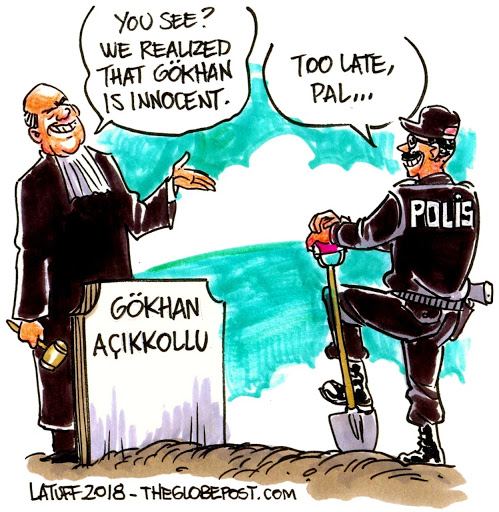
A year and a half after his passing away, the courts (government) found him not guilty (not that I believe in court verdicts) and sent a statement to his home saying that he has been reinstated to his teaching position with a simple apology attached.

Yes, what I am saying sounds unbelievable but it is all backed up with written and visual evidence. The government fired him, tortured him, took away his life, refused him a religious burial, and in the end reinstated him and said sorry. They did not even pay attention to the fact that they killed Gökhan before they sent the apology letter to his home.

“They did not even pay attention to the fact that they killed Gökhan before they sent the apology letter to his home. “

A caricature drawn by Carlos Latuff in 2018

There are many more details to his story but I would like to finish by saying that the founder of the Graveyard for Traitors, Kadir Topbaş died because of COVID-19 in the past year. As a Muslim, I believe in only one court of justice where the teacher Gökhan and the governor of Istanbul will be seen as equals. He will not need his glasses to bear witness to him in that court and all oppressors will be judged harshly regardless of the positions they held on Earth.

Note #1: If you would like to look into more examples of police brutality and the death of justice in Turkey, I suggest that you visit the website for the Tenkil Museum where the objects of people who lost their lives to the Erdogan regime are exhibited. There are also objects of those who had to leave Turkey through the Maritsa River in flimsy boats exhibited in the museum. These objects are witnesses to a terrorist state.

Note #2: Most of the factual information on this post (timeline, witness statements, documents, and videos) is from the Bold Medya website which is in Turkish.

Categories
POLITICS TURKEY

From Posting a Tweet to Sleeping Inside the Turkish Parliament: The Case of Ömer Faruk Gergerlioğlu

Ömer Faruk Gergerlioğlu, a Member of the Parliament from the pro-Kurdish party HDP (People’s Democratic Party) was stripped of his MP status last Wednesday in Ankara/Turkey. The court order condemning him to a two and a half year prison sentence was read in the Turkish Parliament while other HDP members banged on their desks in protest. And the reason for the court order? It’s a tweet he shared in 2016.

Gergerlioğlu after the court order has been read in the Parliament (AP)

In his tweet dated 2016, Gergerlioğlu shared a news article by T24. The article is about a PKK (Kurdistan Workers’ Party) statement that says “peace with the Turkish government will be achieved in a month if the government takes a step towards negotiating”. On this news article, Gergerlioğlu  commented “There should be a response to this call because there is no end to this problem”. His tweet was considered “terrorist propaganda” by the courts in 2018 and Gergerlioğlu was sentenced to two and a half years in prison. But why was his sentence approved now in 2021? The answer is clear. It is because he has been making a lot of noise in the Turkish Parliament.

A Short History of PKK and the Peace Negotiations with the Turkish Government

The Kurdistan Workers’ Party (PKK) was formed in 1978 with an emphasis on armed struggle for Kurdish independence in Turkey after the government forced systematic assimilation on Kurds such as banning the use of Kurdish language. The first armed assaults against the Turkish military started in the early 1990s. The attacks later included the killing of the civilian population using tactics like placing bombs in crowded areas or suicide bombings. At the height of the armed conflict between PKK and the Turkish government in 1994, there have been 5000 civilian deaths related to terrorism.

During the peace negotiations between the Turkish government and PKK (2009-2015), the number of deaths decreased drastically to 20-50 per year. Unfortunately, these negotiations started crumbling after the pro-Kurdish political party HDP got 13% of the votes in the 2015 General Elections. The victory of HDP caused the ruling Justice and Development Party (AKP) to lose majority rule after being the leading party for the last 12 years. 

As Turkey got ready for another election due to Erdogan’s inability to form a majority government, the Turkish military intensified its violence in the Eastern regions of Turkey where the majority of the Kurdish population reside. The PKK also started attacking the Turkish forces, and the death of two Turkish policemen in Ceylanpınar created polarization in the population. The peace negotiations officially ended and the number of deaths rose over 500 once again after a long period of peace. As a result, the Justice and Development Party was able to gain the majority of seats in the next election. Since then, Erdogan has expanded his presidential powers in the 2017 referendum and the rule of law has been affected the most. In this political environment, Gergerlioğlu’s tweet calling for peace between the government and PKK posed a threat to the regime and he was charged with spreading “terrorist propaganda”.

Gergerlioğlu as a Human Rights Activist

Gergerlioğlu has been a human rights activist for more than 20 years. In the past, he has advocated for human rights as the President of Mazlumder – an Islamist association found to protect civil rights in Turkey. He has also participated in many other organizations that advocate for peace and minority rights over the years.

In 2016, he was suspended from his role as a medical doctor in a public hospital as part of the government purges against members of the Gulen Movement. Since the attempted coup in 2016, the government has been accusing members of the Gulen Movement of “being a member of a terrorist organization”. This accusation is also being used to oppress others who criticize government policies even when they do not have any ties to the Gulen Movement, which has been the case for Gergerlioglu. The effects of these purges have been drastic. People describe it as being handed a “social death sentence”. Those who have lost their jobs are unable to find any other positions even in the private sector and are excluded from social life in most cases.

After losing his position in the hospital, Gergerlioğlu became a member of the parliament in 2018 and has been bringing forth accusations regarding the human rights violations committed by the Turkish government in the Parliament. He has advocated against torture, arbitrary naked searches, and unsanitary living conditions in Turkish prisons. He is also standing up against the arbitrary jailing of pregnant women and terminally ill patients.

He states that during his election, only 90 thousand people had voted him in, but in these past 2 years, he became someone who represents millions that need representation. People who have been purged from their jobs by unlawful decrees, people with loved ones in prison, others who have been oppressed in many different ways have all found refuge in Gergerlioğlu. He listens to people who have been made to feel worthless in Turkish society and brings forth their problems in the Parliament to make their issues visible. This is why he is being specifically targeted by the media and other members of the Parliament. He is giving people courage to speak up and make change.

What Is Next?

Gergerlioğlu has stated that he does not accept the unlawful court order and that he will not be leaving the Parliament until justice is restored. He has been sleeping in the private room of HDP inside the Parliament and keeps on hosting live broadcasts on Twitter with other human rights advocates and members of the Parliament. I do not know if the government will send police forces into the Parliament to detain Gergerlioğlu or if there will be any kind of resolution without the use of violence. All I know is that he is teaching the people in Turkey and all around the world a valuable lesson on how to resist courageously against injustice and oppression.

Gergerlioğlu (sitting in the middle, wearing a blue mask) with other HDP MPs who are showing their support for him (AP)